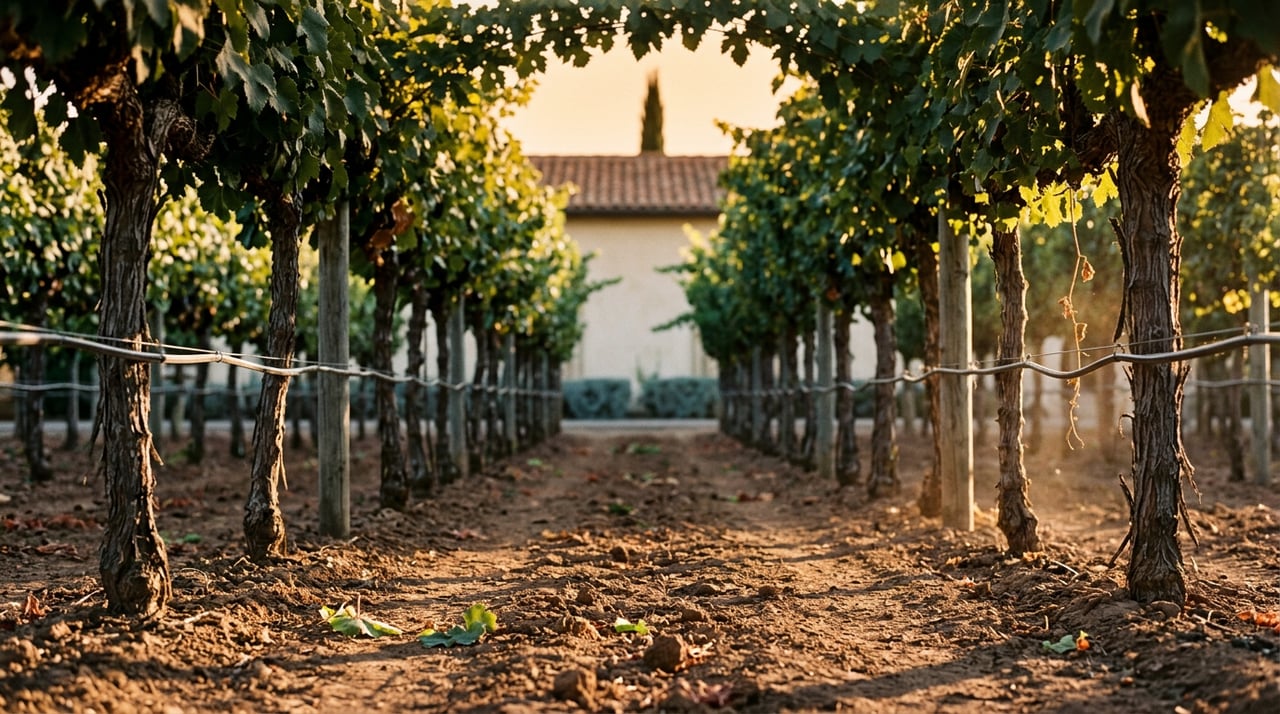
Drive down Zumaque or El Vuelo on a Saturday morning and you'll pass at least one property where the citrus used to be. A quarter acre of trellised vines behind a stucco wall, maybe a drip line snaking between rows, nothing that looks like an announcement. Most people who live here have learned to read these small vineyards as a hobby, the kind of thing a neighbor does on weekends instead of golf.
That read is now out of date. On August 14, 2026, the federal Alcohol and Tobacco Tax and Trade Bureau published a formal proposal in the Federal Register to establish the "Rancho Santa Fe" American Viticultural Area, a 15,827-acre appellation carved out of the existing South Coast AVA. This is not a community newsletter update. It is a government agency putting a petition out for public comment, the same process that created Napa Valley and Paso Robles as legal wine regions. The backyard hobby has a docket number now.
The Application That Quietly Went Federal
The petition covers a lot of ground on paper. Within that 15,827-acre boundary, the filing counts approximately 30 commercial vineyards. What it does not say outright, but what the underlying reporting makes clear, is how small those vineyards actually are. A 2023 industry survey of the same growers put the total vine acreage at roughly 14 acres. The AVA is a 15,827-acre appellation with about 14 acres of actual vines in it. That gap is the whole story of what kind of wine region this is: not a valley of contiguous vineyard blocks, but two dozen or so residential lots where someone decided to plant Bordeaux clones instead of a second lemon grove.
The path here started with one property. Jon Williams planted 1,000 vines on the hillside behind his home in 2006, more as an experiment than a business plan. The vines did well enough that he and his wife Tammy released their first vintage in 2012 under a label now known as The Cov, short for Covenant. You can find it on the list at Mille Fleurs, and it gets poured at the Rancho Santa Fe Golf Club from time to time. Other growers followed once the Williams vineyard proved the ground could produce something worth drinking. David Gamboa, a founding member of the growers' group that eventually formed, tore out an 800-tree lemon grove and put in 450 vines of cabernet sauvignon. Jay Flatley planted a pair of cabernet sauvignon clones on a sun-facing hillside and brought in Barbour Vineyards to install them, consulting with winemaker Sam Kaplan of Arkenstone Vineyards on which clones would actually take. By 2023, one report on the group put the single largest vineyard in the community at 2,500 vines, still a backyard by wine-country standards, but a serious one.
Those growers formed the Rancho Santa Fe Vintners and Growers Association in 2021 specifically to pursue federal recognition, and the group has been the engine behind the petition since. "We are quite confident the RSF region is truly unique," Gamboa said when the effort was still in its early stages. Getting the federal government to agree with him took years of soil surveys, climate data, and a petition the group describes as running roughly 150 pages.
Why the Government Cares About a Failed Timber Crop
The scientific case in the petition rests on two things, and one of them is almost accidental. The community's name traces back to 1906, when the Santa Fe Railway bought up the old San Dieguito Land Grant with the intention of growing timber for railroad ties. Between 1906 and 1914, the railway planted 3.5 million eucalyptus trees across the property. The wood turned out to be useless for railroad construction. But the trees stayed, and more than a century later, groves of that same eucalyptus are doing something nobody in 1910 could have predicted for a vineyard's benefit.
Research cited in the petition, originally from the Australian Wine Research Institute, found that a compound in eucalyptus leaves called 1,8-cineole can be absorbed through grape skins, producing a distinct minty, eucalypt character in the finished wine. Most of the vineyards in the proposed AVA sit close to these century-old groves, and the petition argues that proximity is part of what makes wine from this specific patch of ground taste different from wine grown a few miles away. A failed 1906 timber investment turned into a 2026 flavor profile.
The climate case is more conventional but no less specific. The petition documents that Rancho Santa Fe consistently logs fewer growing-degree-days than the AVAs around it, the result of marine-layer fog and ocean breezes moving in from five miles away. Rainfall runs lower here too, less than nearly every neighboring wine region except the one directly to the south. Katarina Jemec Parker, the GIS analyst who authored the petition, has pointed to the area's remarkably even terrain as part of what sets it apart, describing a mean elevation of 184 feet with no point in the entire AVA rising above 553 feet. Add sedimentary loam soils over sandstone and mudstone, and you get a growing environment that's unusually consistent from one vineyard to the next, even when those vineyards are separated by half a mile of horse property and someone's tennis court.
None of this happens on typical wine-country acreage, and the petition says so directly. Rancho Santa Fe's own community bylaws require a minimum of two acres per residential lot, which is normally a zoning detail with nothing to do with viticulture. Here it's cited as the reason boutique vineyards can exist at all in a region this developed. Two-acre lots leave just enough room for a few hundred vines behind the pool and the guest house.
The Question the Board Hasn't Answered
The petition clearing the science stage is not the same as the community having settled every question about it. The Rancho Santa Fe Association's own governing document, the Protective Covenant, prohibits the sale or manufacture of malt, vinous, or spirituous liquors on Association property. That clause predates the entire wine effort by decades, and nobody wrote it with a vineyard in mind. But it is still on the books, and the Association's board has had to grapple with what it means for a community project built entirely around wine.
In February 2023, the board voted to contribute $5,000 toward the growers' AVA petition, a vote of confidence in the project. In the same meeting, Director Greg Gruzdowich acknowledged that the Covenant gives the board some discretion here, but said the question would need to be looked into further. That review does not appear to have produced a public resolution since. The board has funded the effort to put Rancho Santa Fe's name on a wine label while leaving open whether its own founding document technically allows wine to be made on its land. Board president Dan Comstock also noted at that meeting that some residents had raised concerns about pesticide drift from vineyards affecting neighboring properties, a reminder that not every homeowner near a vineyard signed up to live next to one.
None of this is a scandal. It is the kind of unglamorous, procedural loose end that never makes it into a magazine feature about wine country, but that shapes what actually gets built here over the next few years. The science is settled enough to satisfy a federal agency. The community's own rulebook is still catching up.
What Changes, and What Doesn't
If the TTB approves the petition, wine made from grapes grown inside the boundary could carry "Rancho Santa Fe" as its appellation of origin, or "South Coast," or both, depending on what the label wants to claim. That's a real benefit for the two dozen or so growers who've spent years building toward this, and it's a marketing distinction the growers' association has said could raise land values and put the community on the map the way Ramona Valley and San Pasqual have already done for their own smaller AVAs in this county.
It does not mean a wave of new vineyards is coming to every two-acre lot in the Covenant, and it doesn't change anything about how existing residential property here can be used. TTB's public comment period is open now, and the agency is specifically asking whether the boundary, the climate data, and the case for distinguishing this area from the surrounding South Coast AVA hold up to scrutiny. If the pace of other San Diego County petitions is any guide, patience will matter. The Rancho Guejito AVA, another San Diego County proposal, was first filed in 2021 and was still pending years later. This one moved from a "perfected" petition in January 2023 to a published Federal Register notice in August 2026, more than three years between those two federal milestones.
So if you drive past that quarter acre of vines again this fall, the honest update is this: it's still someone's weekend project, and it will probably still look like one for a while. But it's also, as of this year, sitting inside a federal boundary that could put a permanent word on wine labels sold well beyond the Covenant. Both things are true at once, and that's usually how the most interesting changes in a place like this actually arrive: quietly, on a property you've driven past for years, long before anyone puts up a sign.
If you're curious how developments like this factor into the value of a home here, or you're weighing a move within the Covenant and want someone who tracks this level of local detail, Tanya Williams offers a free home valuation and can walk you through what's actually happening in your corner of Rancho Santa Fe.